
Key points
- A lyophilised peptide is a porous cake produced by freeze-drying [13], [9], and reconstitution is adding a diluent back to it so it dissolves into a solution again [8]; a retatrutide reconstitution calculator works out the resulting concentration, and the volume that holds a chosen sample mass, as arithmetic on the numbers a reader selects.
- The phase 1b trial measured a half-life of approximately 6 days and dose-proportional pharmacokinetics, which its authors report as supporting once-weekly dosing [3].
- The phase 2 obesity trial recorded a mean change in body weight of -24.2% at 48 weeks on the 12 mg dose against -2.1% on placebo, in 338 adults [1].
- Bacteriostatic water is water for injection carrying 0.9% (83.2 mM) benzyl alcohol as a preservative, and one formulation review reports that the same preservative can also speed protein aggregation and lower a formulation's apparent melting temperature [8].
- Lyophilisation removes water from a frozen peptide solution under vacuum, and lyoprotectants such as sugars and polyols are added beforehand to limit the aggregation and structural change the drying process itself can cause [9].
- Retatrutide is not approved for human use in the UK or anywhere else and remains under clinical development [1], [4].
Listen to the summary
A short two-voice summary of this guide.
Transcript
- Host
- This guide is about a retatrutide reconstitution calculator. Before the arithmetic, what actually happens when a peptide is reconstituted?
- Researcher
- A peptide like this can be freeze-dried into a dry cake inside its vial, a process the formulation literature calls lyophilisation. Reconstitution means adding a liquid, a diluent, back to that cake so it dissolves into a solution. Once it is dissolved, the amount of peptide in each millilitre depends on how much diluent went in.
- Host
- And that is the arithmetic the calculator on this page does?
- Researcher
- Exactly. Concentration is the mass in the vial divided by the volume of diluent. The volume that holds any smaller amount of peptide is that amount divided by the concentration. The calculator also reads that volume off a U-one-hundred insulin syringe scale, which marks one millilitre in a hundred equal units.
- Host
- Where does bacteriostatic water come into it?
- Researcher
- It is water for injection carrying a preservative, benzyl alcohol, at zero point nine percent. One formulation review we cite describes that exact concentration when it discusses reconstituting peptides. The same review found that the preservative can speed up how fast some proteins clump together, and can lower the temperature at which they start to unfold, so it is not a neutral addition.
- Host
- And retatrutide itself, what do the trials say it is?
- Researcher
- It was first published under the code L-Y-three-four-three-seven-nine-four-three. It acts as an agonist on three receptors at once, called GIP, GLP-one and glucagon. In a phase one b trial of seventy-two adults with type two diabetes, its half-life measured about six days, which supported giving it once a week. In the phase two obesity trial, three hundred and thirty-eight adults lost, on average, twenty-four point two percent of their body weight at forty-eight weeks on the highest dose studied, against two point one percent on placebo.
- Host
- Do the trial reports say how retatrutide itself was reconstituted?
- Researcher
- No. None of the trial reports we have describe how the study vials were prepared. Everything in this guide about freeze-drying, bacteriostatic water and peptide stability comes from the general pharmaceutical literature on peptides of this kind, not from a description of retatrutide's own trial supply.
- Host
- And where does retatrutide stand today?
- Researcher
- It is not approved for human use anywhere, including the UK. It remains under clinical development, with further trials registered and, in one case, already completed.
- Host
- So none of this is instructions for using it.
- Researcher
- No. Every figure I have given, the concentrations, the percentages, the half-life, is in the guide itself with the source it came from.
What reconstitution is, and what the retatrutide reconstitution calculator computes
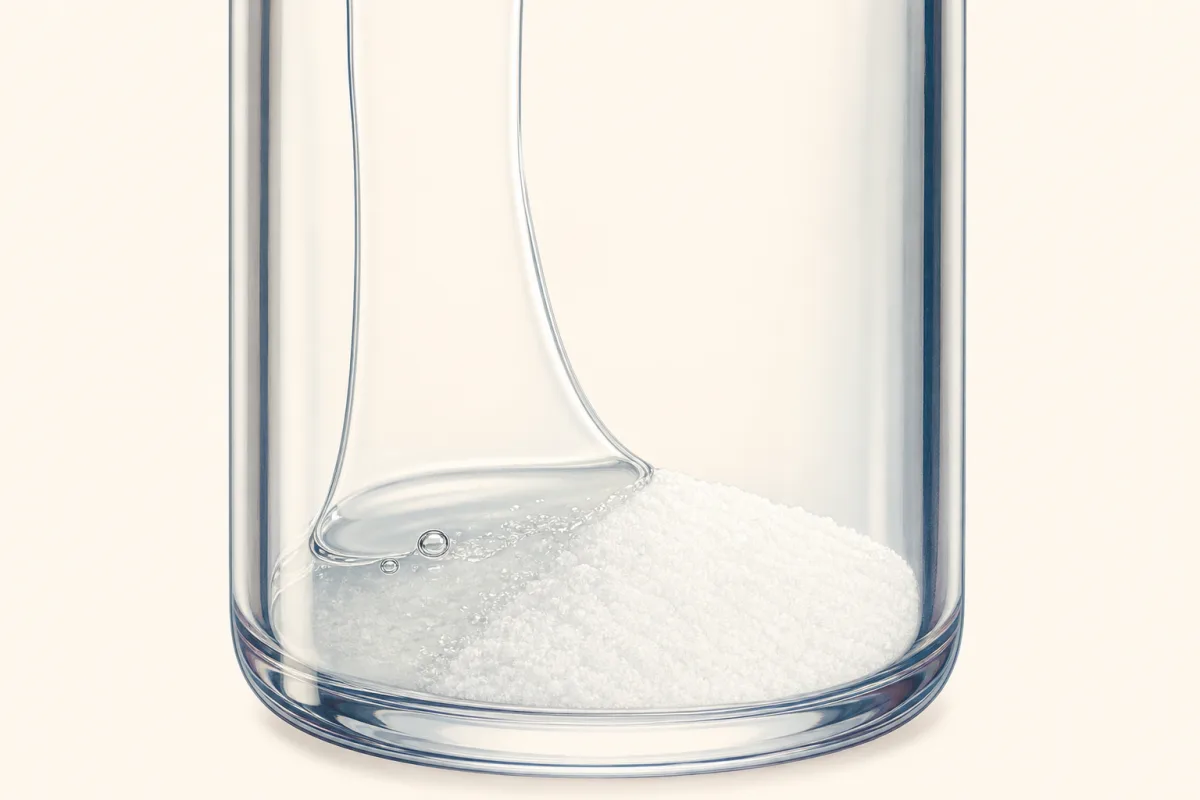
A lyophilised peptide vial holds a dry cake rather than a liquid: the water has been removed from a frozen peptide solution under reduced pressure, a process the pharmaceutical literature calls lyophilisation, or freeze-drying, in which product temperature must stay below the formulation's glass transition temperature to keep the cake from collapsing [9]. Bulking agents give that cake its mechanical strength and its porous structure, which is what lets the water sublime out of it efficiently in the first place [13]. Reconstitution is the same literature's term for adding a diluent back to a lyophilised product so it dissolves into a solution again before it can be measured or handled as a liquid [8]. The retatrutide reconstitution calculator on this page works out how a vial's stated mass, a chosen diluent volume and a chosen sample mass relate to one another arithmetically, without saying what a reader should do with any of the three.
The arithmetic itself needs no source: a concentration is a mass divided by the volume it is dissolved in, and the volume that holds any given smaller mass of that same solution is that mass divided by the concentration. A U-100 syringe marks one millilitre in a hundred equal units, so the same volume can also be read as a number of units on that scale.
Reconstitution calculator
The arithmetic of a lyophilised vial: the mass in the vial over the volume added is the concentration, and from it the volume that holds any given mass follows. It describes a solution on the bench, not a use.
Peptide in the vial
Diluent added
Mass in a sample
Syringe scale
Concentration
10 mg/mL
100 µg in one unit, a hundredth of a millilitre
150 µg of peptide is in 0.015 mL of this solution, which reads 1.5 units on a 1 mL syringe.
Every figure here is arithmetic on the values chosen above. It describes a solution in a laboratory; nothing on this page describes a use in people.
| 10 mg | 1 mL | 10 mg/mL | 0.03 mL | 3 |
| 10 mg | 2 mL | 5 mg/mL | 0.06 mL | 6 |
| 20 mg | 2 mL | 10 mg/mL | 0.03 mL | 3 |
| 30 mg | 3 mL | 10 mg/mL | 0.03 mL | 3 |
| 60 mg | 3 mL | 20 mg/mL | 0.015 mL | 1.5 |
Source [8]
What retatrutide is, according to its trials
Retatrutide, first published under the developer code LY3437943, is a single peptide engineered to act as an agonist at three receptors at once: the glucose-dependent insulinotropic polypeptide (GIP) receptor, the glucagon-like peptide 1 (GLP-1) receptor and the glucagon receptor [4]. Three trials in people are described in this guide: a phase 1b trial in adults with type 2 diabetes, and phase 2 trials in obesity and in type 2 diabetes, each giving retatrutide by once-weekly subcutaneous injection under a registered protocol [1], [2], [3].
In obese mice, the discovery paper attributes body weight loss to calorie intake reduction driven by GIP and GLP-1 receptor activity, augmented by glucagon receptor-mediated increases in energy expenditure; in vitro the same paper reports balanced glucagon and GLP-1 receptor activity alongside greater GIP receptor activity [4]. A single-dose, phase 1 study cited in the same paper found that a reduction in body weight persisted up to day 43 after one dose, and that the pharmacokinetic profile supported once-weekly dosing [4].
In the phase 1b trial, 72 adults with type 2 diabetes received once-weekly subcutaneous LY3437943, placebo or dulaglutide over 12 weeks at four centres in the USA; its pharmacokinetics were dose proportional and its half-life was approximately 6 days [3]. The trial's authors report that this pharmacokinetic profile, together with pharmacodynamic findings of reductions in glucose and bodyweight, supported moving to phase 2 development [3].
Body weight, 48 weeks
-24.2%
Phase 2 obesity trial, 12 mg dose, once weekly, against -2.1% on placebo
Half-life
6 days
Phase 1b trial in adults with type 2 diabetes, pharmacokinetics dose proportional
Adults, obesity trial
338
Phase 2 obesity trial, placebo controlled, once weekly for 48 weeks
Adults, diabetes trial
281
Phase 2 trial in adults with type 2 diabetes, 42 centres in the USA
Randomised trial · 2023Mean change in body weight at 48 weeks of -8.7%, -17.1%, -22.8% and -24.2% by dose against -2.1% on placebo, with gastrointestinal adverse events the most common, dose related and mostly mild to moderate
- Design
- Phase 2, double-blind, randomised, placebo-controlled trial
- Population
- 338 adults with a body-mass index of 30 or higher, or 27 to less than 30 with a weight-related condition
- Intervention
- Once-weekly subcutaneous retatrutide at 1 mg, 4 mg, 8 mg or 12 mg, or placebo, for 48 weeks
- Finding
- Mean change in body weight at 48 weeks of -8.7%, -17.1%, -22.8% and -24.2% by dose against -2.1% on placebo, with gastrointestinal adverse events the most common, dose related and mostly mild to moderate
Randomised trial · 2023Reported as clinically meaningful improvements in glycaemic control and robust reductions in bodyweight against placebo, with a safety profile consistent with GLP-1 and GIP/GLP-1 receptor agonist classes; the data informed dose selection for the phase 3 programme
- Design
- Randomised, double-blind, double-dummy, placebo- and active-comparator-controlled, parallel-group phase 2 trial
- Population
- 281 adults aged 18 to 75 with type 2 diabetes, HbA1c 7.0% to 10.5% and BMI 25 to 50 kg/m2, at 42 centres in the USA
- Intervention
- Once-weekly placebo, dulaglutide 1.5 mg, or retatrutide at 0.5 mg, 4 mg or 8 mg (each with two escalation schedules) or 12 mg
- Finding
- Reported as clinically meaningful improvements in glycaemic control and robust reductions in bodyweight against placebo, with a safety profile consistent with GLP-1 and GIP/GLP-1 receptor agonist classes; the data informed dose selection for the phase 3 programme
Randomised trial · 2022Pharmacokinetics dose proportional with a half-life of approximately 6 days; an acceptable safety profile and pharmacodynamic findings of robust reductions in glucose and bodyweight supported moving to phase 2
- Design
- Phase 1b, proof-of-concept, double-blind, placebo-controlled, randomised, multiple-ascending dose trial at four centres in the USA
- Population
- 72 adults aged 20 to 70 with type 2 diabetes for at least 3 months, HbA1c 7.0% to 10.5%, BMI 23 to 50 kg/m2, stable bodyweight
- Intervention
- Once-weekly subcutaneous LY3437943, placebo, or dulaglutide 1.5 mg, over 12 weeks
- Finding
- Pharmacokinetics dose proportional with a half-life of approximately 6 days; an acceptable safety profile and pharmacodynamic findings of robust reductions in glucose and bodyweight supported moving to phase 2
Bacteriostatic water and what benzyl alcohol does
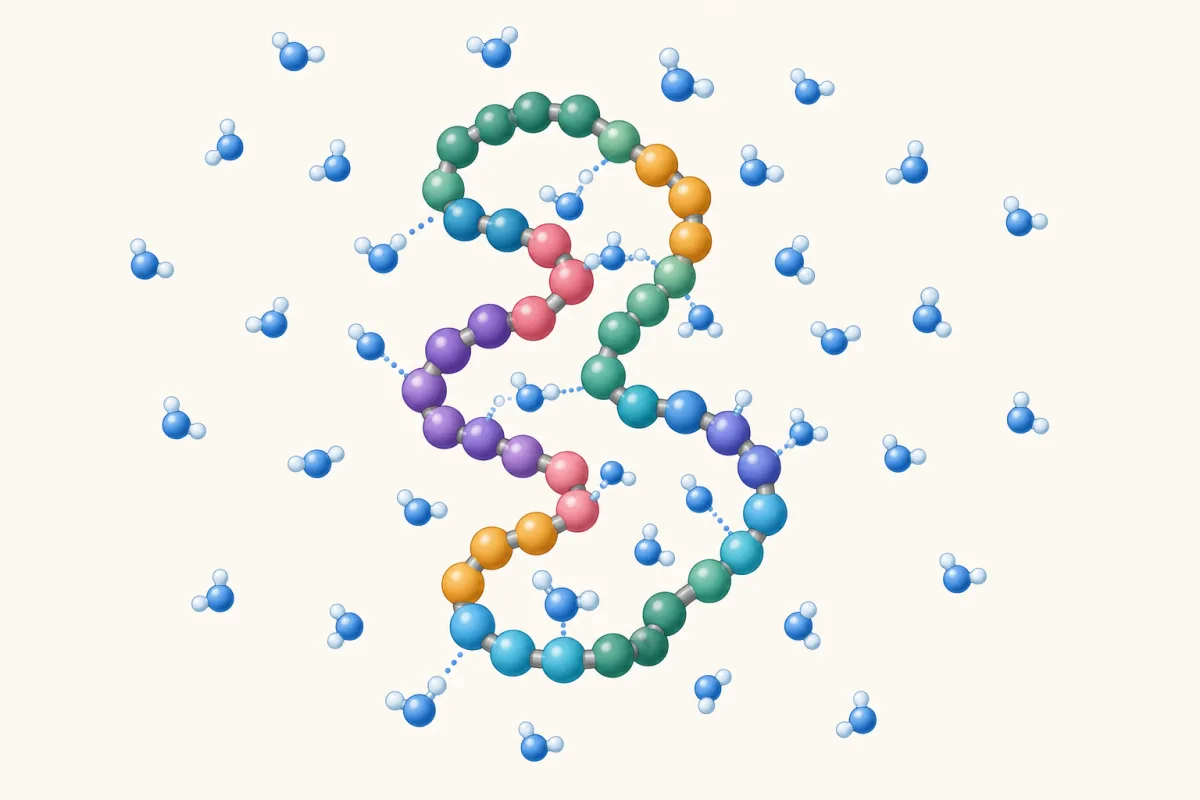
One review of antimicrobial preservatives in protein and peptide formulations covers, by its own account, which preservatives suit these formulations, their physico-chemical properties, their compatibility with other excipients and packaging, their interactions with the biological compound, and an overview of licensed protein and peptide products that use them [8]. Bacteriostatic water is water for injection carrying 0.9% w/v (83.2 mM) benzyl alcohol as an antimicrobial preservative, the concentration the same review describes when it discusses reconstitution with bacteriostatic water [8]. It also reports that biological drugs intended for multi-dose use require an antimicrobial preservative to avoid microbial growth [8].
Benzyl alcohol's antimicrobial effect is pH dependent: the review reports it is most efficient at a pH below 5 and has little antimicrobial effect at values above pH 8 [8]. It also reports a membrane-active mechanism, increasing membrane fluidity and interfering with bacterial membrane properties such as efflux pumps [8].
The review also reports the preservative's effect on the protein it sits beside. In one study it summarises, a formulation containing 0.9% benzyl alcohol aggregated faster than a negative control with no preservative, the monomer fraction falling by almost 60% against about 10% in the control after two days of incubation at 37 degrees Celsius [8]. Differential scanning calorimetry in the same body of work found the apparent melting temperature falling from 56 degrees Celsius in the control to 51, 48 and 44 degrees Celsius at benzyl alcohol concentrations of 0.9%, 1.5% and 2.0% [8].
The review's opening point is that a preservative like this answers a specific need, a vial drawn from more than once; it does not describe what a single-use, preservative-free diluent would be called or how it would behave with any particular peptide, and this evidence set does not describe which diluent, if any, was used to prepare retatrutide in its own trials [8].
Lyophilisation and the stability of peptides in solution
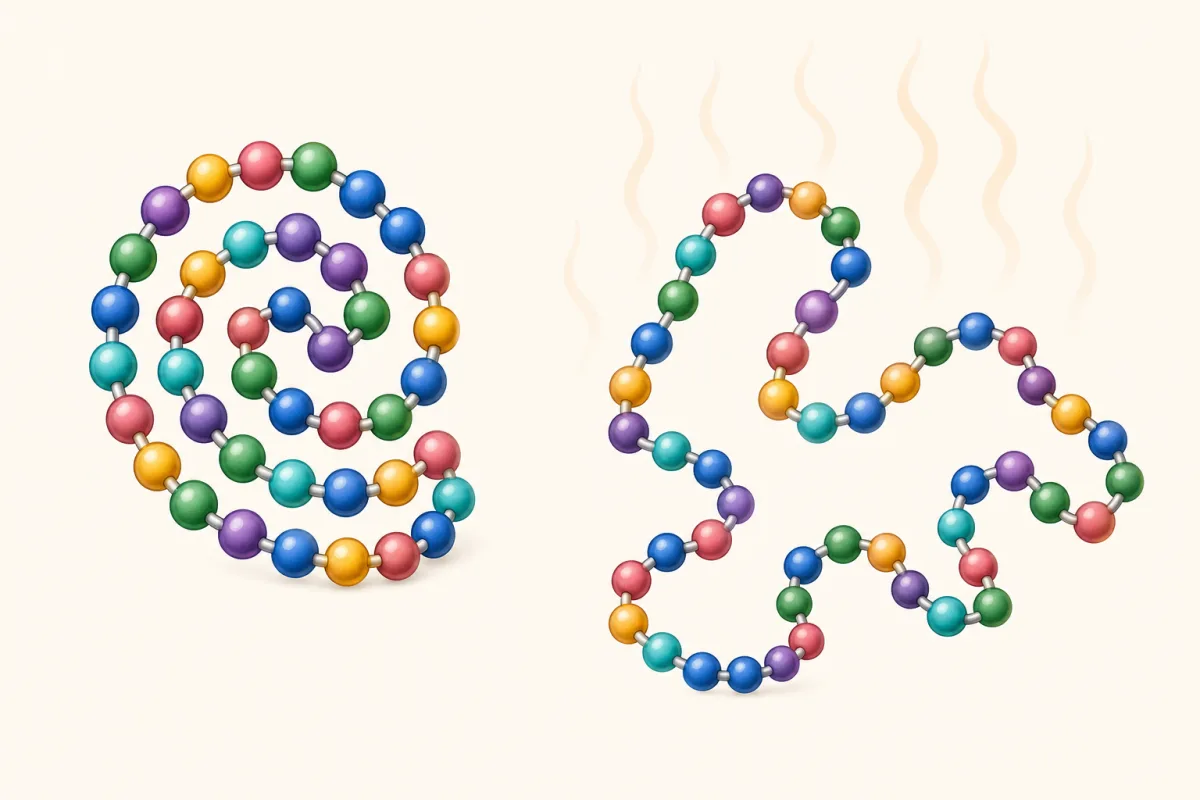
Freeze-drying removes water from a frozen solution under vacuum so that a peptide is left as a solid cake rather than a liquid, and lyoprotectants such as sugars, polyols, amino acids and polymers are added beforehand to limit the damage the process itself can cause: ice formation, dehydration-driven aggregation and destabilisation at the ice-water interface, as one 2026 review of stabilisation strategies for biologicals describes [9]. The same review reports that 85% of commercial conjugates rely on lyophilisation, and that sucrose-trehalose combinations and controlled ice nucleation are emphasised for preserving particle integrity [9].
Once a peptide is back in solution, how it folds and how it aggregates are coupled processes: a 2026 review of GLP-1 analogue structural dynamics reports that ionic concentration and temperature both affect conformation, and that manufacturing processes act as external perturbations that can affect structural integrity [10]. Two peptide-specific studies give that finding numbers.
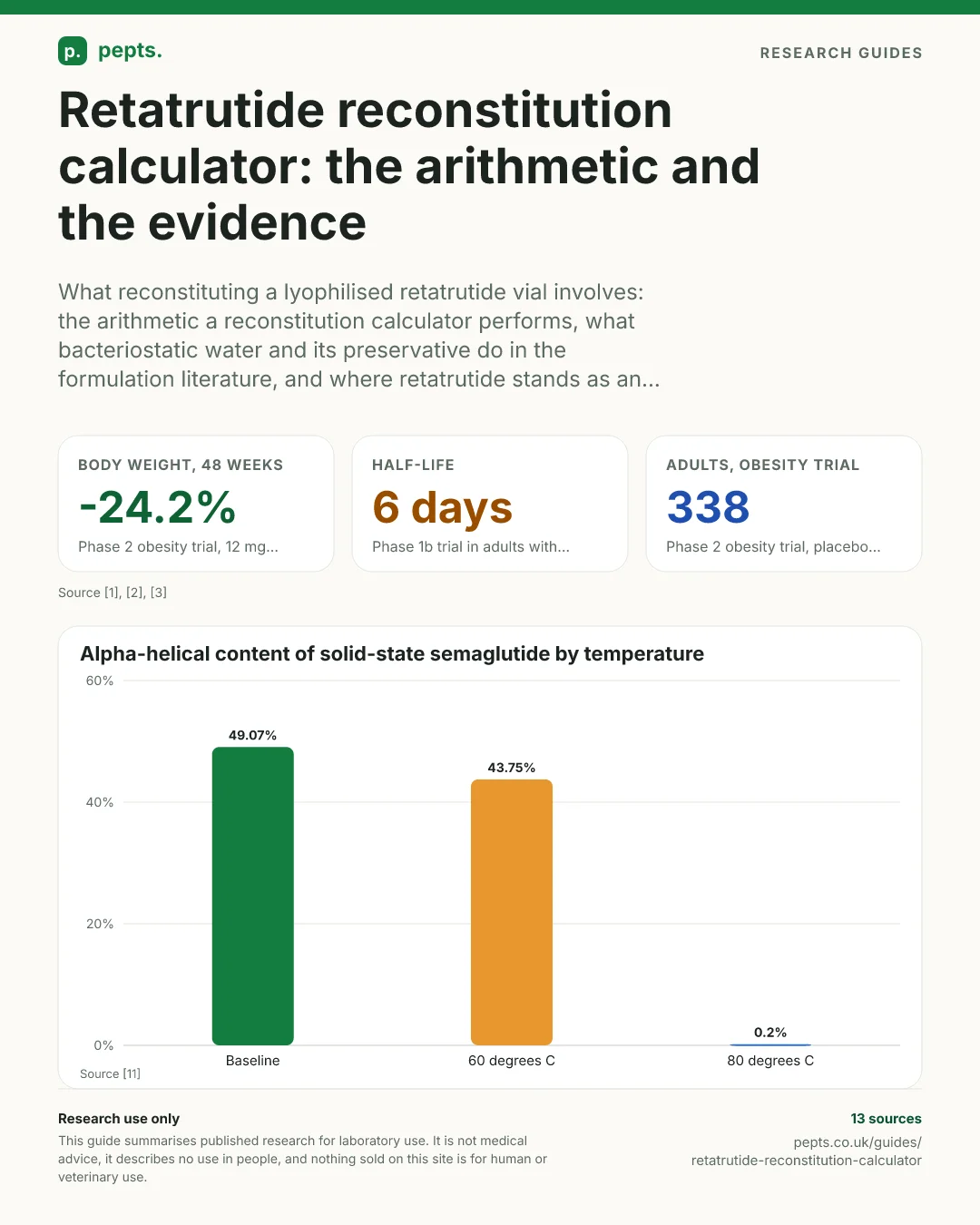
Solid-state semaglutide, a GLP-1 receptor agonist studied for its solid-state stability, keeps its native alpha-helical conformation up to 60 degrees Celsius by one measure, while a companion measurement in the same study found its alpha-helical content falling from 49.07% to 43.75% at 60 degrees Celsius and further to 0.2% at 80 degrees Celsius, alongside temperature-dependent degradation the same study measured by high-performance liquid chromatography and mass spectrometry [11]. Glucagon in aqueous solution is described in a separate study as prone to aggregation, with structural destabilisation beginning at its C-terminal region while an internal segment, residues 11 to 14, stays structured across every formulation tested [12].
Circular dichroism and infrared measurements of semaglutide, a GLP-1 receptor agonist, held as a solid and heated to two temperatures, reported as the proportion of the peptide retaining its native alpha-helical fold.
Semaglutide is measured here as an example of heat-driven conformational change in a GLP-1-class peptide; the source excerpts describe no equivalent measurement for retatrutide, and 'baseline' is the study's own starting figure rather than a stated temperature.
Source [11]
Short peptides themselves can serve as excipients in these formulations: one review reports they have been used as stabilisers, antioxidants, viscosity-lowering agents, and as lyo- or cryoprotectants or bulking agents in lyophilised products [13].
Vial sizes and the reconstitution arithmetic
Retatrutide is supplied on the shelf as a lyophilised cake of the kind the formulation literature describes [13], in sizes from 10 mg to 60 mg, and the calculator above offers a spread of diluent volumes a vial of this kind takes when it is dissolved [9]. Reconstituting the same vial in a smaller volume of diluent produces a solution of higher concentration, and reconstituting it in a larger volume produces one of lower concentration, because the mass in the vial is fixed while the volume it is dissolved into is not; a larger vial dissolved into the same volume as a smaller one is, likewise, more concentrated than the smaller vial would be. The table earlier in this guide sets out that arithmetic for five such combinations; the figure below draws together this guide's headline figures.
Retatrutide in the UK: an investigational compound
Retatrutide has no marketing authorisation in the UK or anywhere else: every trial report gathered for this guide describes it as under clinical development for type 2 diabetes, obesity and related conditions, not as a licensed medicine [1], [2], [3]. Three further trials are registered on ClinicalTrials.gov without full published results in this evidence set: a completed trial, TRANSCEND-T2D-1, investigating retatrutide against placebo in adults with type 2 diabetes over about 11 months with up to 11 visits [5]; an earlier, completed study of LY3437943 in adults with type 2 diabetes inadequately controlled by diet and exercise or metformin, planned to last about 43 weeks [6]; and a two-part pharmacokinetic study in healthy participants with a high body-mass index, comparing injection sites in one part and intravenous administration in the other, with a total duration of up to 157 days in the first part and 99 days in the second [7].
Retatrutide is not approved for human use in the UK or in any other country, and every trial report cited in this guide describes it as investigational rather than licensed [1], [2], [3], [4]. 'Research use only' in this context describes a substance supplied for laboratory and research purposes rather than for administration to people outside a registered, sponsor-run trial protocol; nothing in this guide describes a use of retatrutide outside such a trial [1], [4].
On our shelf
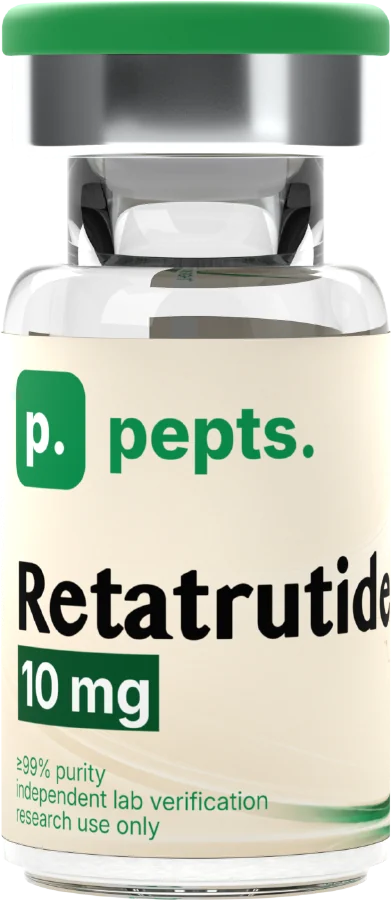
Research-grade Retatrutide, for laboratory use only.
View the listing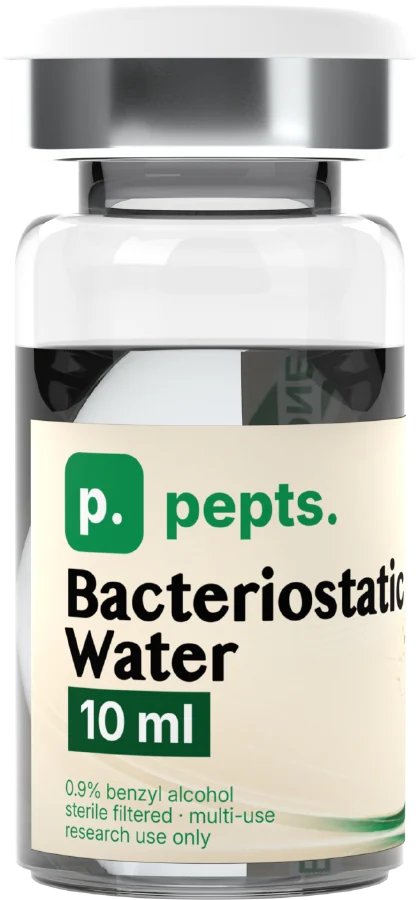
Research-grade Bacteriostatic Water, for laboratory use only.
View the listing
Research use only This guide summarises published research for laboratory use. It is not medical advice, it describes no use in people, and nothing sold on this site is for human or veterinary use.
References
Every figure in this guide points at one of the sources below; the number in brackets is the entry it came from.
- T
Jastreboff AM, Kaplan LM, Frías JP, et al.
Randomised trialThe New England journal of medicine2023 - L
Rosenstock J, Frias J, Jastreboff AM, et al.
Randomised trialLancet (London, England)2023 - L
Urva S, Coskun T, Loh MT, et al.
Randomised trialLancet (London, England)2022 - C
Coskun T, Urva S, Roell WC, et al.
PreclinicalCell metabolism2022 - C
- C
- C
- P
Stroppel L, Schultz-Fademrecht T, Cebulla M, et al.
ReviewPharmaceutics2023DOI 10.3390/pharmaceutics15020563PMID 36839885PMC10217790doi.org
- I
Maharjan R, Shin CY, Lee SK, et al.
ReviewInternational journal of pharmaceutics: X2026DOI 10.1016/j.ijpx.2026.100575PMID 42253757PMC13234487doi.org
- M
Santoro A, Macis M, D'Ursi AM, et al.
ReviewMolecules (Basel, Switzerland)2026DOI 10.3390/molecules31152556PMID 42588408PMC13468180doi.org
- P
Akbar S, Malgave A, Joseph A, et al.
PreclinicalPharmaceutical research2026 - P
Santoro A, Macis M, Buonocore M, et al.
OtherProtein science : a publication of the Protein Society2026 - P
Migoń D, Jaremicz Z, Kamysz W.
ReviewPharmaceutics2025DOI 10.3390/pharmaceutics17101328PMID 41155963PMC12566840doi.org
Questions
How is retatrutide reconstituted?
Reconstitution is the step in which a diluent is added to a lyophilised cake so it dissolves into a solution again [8]; the cake itself is a porous structure produced by freeze-drying [13], [9]. The calculator on this page works out the concentration and volume arithmetic that follows from a chosen vial size, diluent volume and sample mass, and it does not describe a procedure to be carried out.
Does retatrutide need bacteriostatic water?
This evidence set does not state which diluent, if any, was used to prepare retatrutide in its own trials. What it does describe is bacteriostatic water in general: water for injection with 0.9% benzyl alcohol as a preservative, a concentration one formulation review reports in the context of multi-dose biologics [8].
What does the retatrutide peptide calculator work out?
It works out the concentration that a chosen vial size and diluent volume produce, and the volume, in millilitres and in U-100 syringe units, that holds a chosen sample mass at that concentration. Every figure it prints follows from arithmetic on the numbers a reader selects, not from a study result.
Is retatrutide approved in the UK?
No. Retatrutide is not approved for human use in the UK or in any other country; every trial report in this evidence set describes it as under clinical development [1], [4].
What sizes are retatrutide vials?
Retatrutide is supplied on the shelf as a lyophilised cake of the kind the formulation literature describes [13], in sizes from 10 mg to 60 mg.
Why is retatrutide supplied as a freeze-dried cake rather than a ready-made solution?
This evidence set does not describe retatrutide's own manufacturing choices, but the general lyophilisation literature it draws on reports that freeze-drying is a cornerstone technology for the stability of biologicals, with lyoprotectants added to limit the aggregation and denaturation the drying process itself can otherwise cause [9].

