Key points
- MOTS-c is a 16-amino-acid peptide encoded by a short open reading frame within mitochondrial DNA, reported to activate AMPK, chiefly in skeletal muscle [1].
- In mice, MOTS-c treatment prevented age-dependent and high-fat-diet-induced insulin resistance and diet-induced obesity, and enhanced physical performance from young to old age [1], [2].
- In people, studies of circulating MOTS-c report mixed and sometimes null findings: no difference by obesity status in one study, a significantly lower level in one PCOS study and a non-significant rise in another, and a clear rise after exercise [2], [7], [8], [9].
- Two clinical programmes are registered: a completed Phase 1a/1b trial of the analogue CB4211, and a recruiting Phase 2a trial of MOTS-c itself in adults with prediabetes and overweight or obesity, and neither has a published human interventional result yet [6], [12].
- Studies and reviews of mitochondrial-derived peptides describe the receptor-mediated signalling MOTS-c uses and where it comes from in the circulation as still unresolved, and MOTS-c is not approved for human use in any country [3], [5], [6], [12].
Listen to the summary
A short two-voice summary of this guide.
Transcript
- Host
- MOTS-c keeps coming up in mitochondria research. What is it?
- Researcher
- A very short peptide, just sixteen amino acids, and what makes it unusual is where it comes from. It is not encoded in the cell's main genome. It comes from a short open reading frame inside the mitochondrial twelve S rRNA gene, part of mitochondrial DNA itself. It was first reported in twenty fifteen.
- Host
- And what does it do?
- Researcher
- The discovery paper says it inhibits a metabolic route called the folate cycle, which activates AMPK, the cell's main energy-sensing enzyme, mostly in skeletal muscle. A later study adds that it also depends on a second regulator, PGC-1 alpha, and that it lowers oxidative damage inside muscle mitochondria.
- Host
- What has that meant in mice?
- Researcher
- MOTS-c treatment prevented age-related and diet-induced insulin resistance and obesity in the original study. A later paper tested physical performance in young, middle-aged and old mice and found it improved in all three groups, and even a course started very late in life increased physical capacity.
- Host
- And in people?
- Researcher
- That is where it gets interesting, and mixed. Exercise clearly raises the body's own MOTS-c: muscle levels rose almost twelve-fold after a bout of cycling in one study. But studies measuring MOTS-c in disease are inconsistent. One study of eighty-five adults found no difference between those with obesity and those without. Two studies of polycystic ovary syndrome went in opposite directions: one found MOTS-c non-significantly higher in adolescents with the condition, the other found it significantly lower in adult women. A study in people on dialysis and one in heart attack patients each found associations with vascular and cardiac markers, but none of these are trials, they are observations.
- Host
- Is anyone testing it as a treatment?
- Researcher
- Two things are registered. An analogue called CB4211 completed a small early-phase safety trial. And a separate, ongoing trial is testing MOTS-c itself, over twelve weeks, in adults with prediabetes and overweight or obesity, and it is still recruiting. Neither has a published result yet, so MOTS-c stays investigational and is not approved for human use anywhere. Every figure I have given is in the guide with its source.
What is MOTS-c?

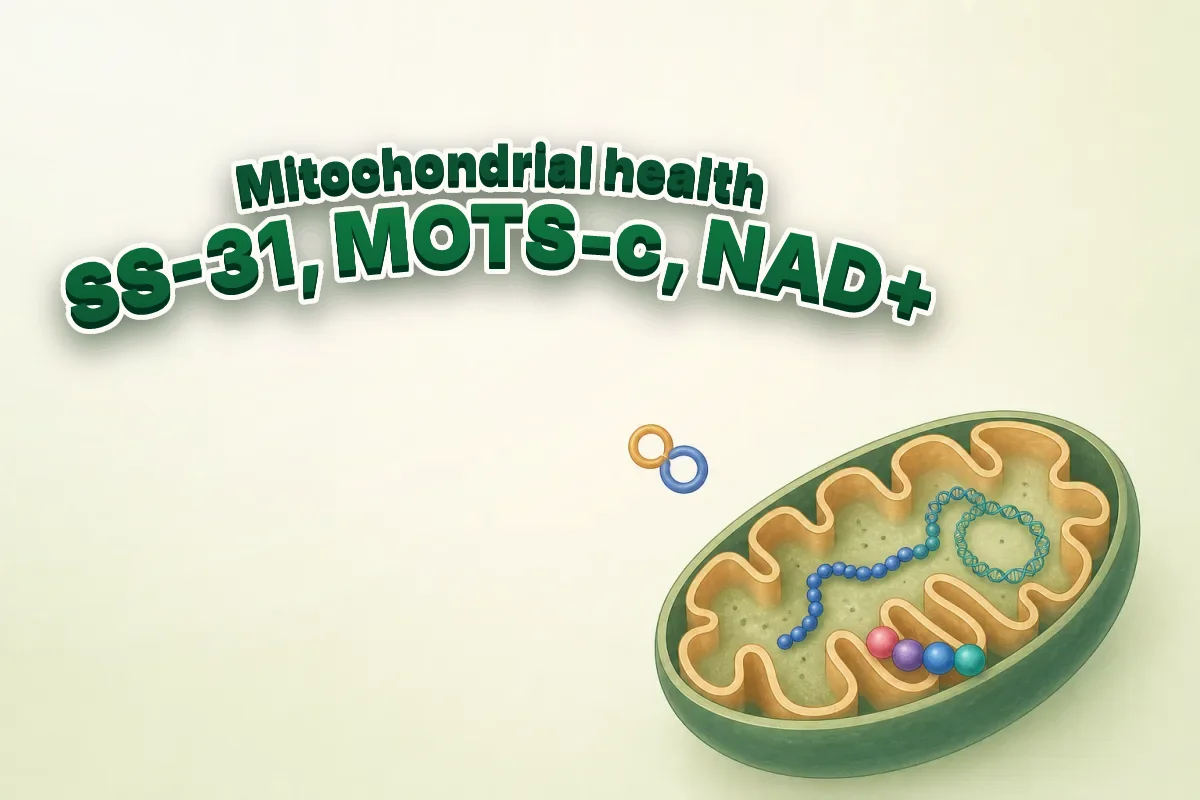
What is MOTS-c? It is a peptide just 16 amino acids long, encoded not in the cell's main genome but within a short open reading frame inside the mitochondrial 12S rRNA gene, part of mitochondrial DNA itself [1]. The name is short for mitochondrial open reading frame of the 12S rRNA-c, and the paper that first reported it describes MOTS-c as regulating insulin sensitivity and metabolic homeostasis, with its primary target organ appearing to be skeletal muscle [1].
MOTS-c belongs to a small family the field calls mitochondrial-derived peptides (MDPs). A 2022 review counts eight published so far: humanin, MOTS-c, and six small humanin-like peptides named SHLP1 through SHLP6 [4]. A 2026 review adds that these peptides act both inside the cell that made them and beyond it, engaging receptors or signalling pathways to regulate nuclear gene expression and metabolic adaptation, and describes MOTS-c specifically as a key regulator of metabolic homeostasis and stress adaptation [5].
- MOTS-c is 16 amino acids long and was first reported in 2015, identified from a short open reading frame within the mitochondrial 12S rRNA gene [1].
- It sits alongside seven other known mitochondrial-derived peptides: humanin and the six small humanin-like peptides, SHLP1 through SHLP6 [4].
- Its discovery paper names skeletal muscle as its primary target organ and AMPK activation as its principal cellular action [1].
How MOTS-c is thought to work: AMPK and mitochondrial signalling

The discovery paper describes MOTS-c's cellular action as inhibiting the folate cycle and its tethered de novo purine biosynthesis, a route that leads to activation of AMPK, the cell's central energy-sensing enzyme [1]. In mice, MOTS-c treatment activated AMPK in skeletal muscle and increased expression of the downstream glucose transporter GLUT4, a change the researchers link to improved muscle glucose uptake [1], [2].
A 2026 study in two distinct transgenic mouse strains reports that MOTS-c augments muscle mitochondrial bioenergetic performance by relying on both AMPK and a second regulator, the transcriptional coactivator PGC-1α [3]. The same study reports that MOTS-c treatment lowered mitochondrial reactive oxygen species emission and the protein damage associated with that oxidative stress, without a detectable change in mitochondrial respiratory protein content, which the authors read as evidence for changes intrinsic to the mitochondria rather than a change in how many there are [3].
Beyond skeletal muscle, a 2026 review on the liver describes MOTS-c as activating AMPK, regulating nuclear gene expression, suppressing fibrotic and inflammatory signalling, and restoring mitochondrial function in models of metabolic dysfunction-associated steatotic liver disease [5]. The same review is candid about the limits of that picture, naming the receptor-mediated signalling networks MOTS-c uses, the crosstalk among mitochondrial, nuclear and cytosolic pathways, and the mechanisms governing how the peptide is trafficked and distributed in the body as questions still open [5].
Because MOTS-c is reported to act both inside the cell that made it and on other tissues at a distance, it has been described as a mitochondrial-encoded hormone or a mitochondrial cytokine, a mitokine [2].
What the mouse studies measured

The 2015 discovery paper reports that MOTS-c treatment in mice prevented age-dependent and high-fat-diet-induced insulin resistance, as well as diet-induced obesity [1].
A 2021 study measured physical performance directly, in mice of three ages: young, at 2 months; middle-aged, at 12 months; and old, at 22 months [2]. MOTS-c significantly enhanced physical performance in all three age groups [2]. Treatment begun late in life, at 23.5 months, and given intermittently three times a week, still increased physical capacity and extended healthspan [2].
The improvement in running capacity did not track body weight: the study reports no correlation between body weight and running time, and reads the effect as an improvement in whole-body energy metabolism rather than a side effect of weight change [2]. It also reports that the duration of treatment was important to enhance performance, which the authors read as a need to reach a certain physiological state with an improved metabolic profile [2].
The same 2021 paper reports that MOTS-c regulates nuclear genes related to metabolism and proteostasis, skeletal muscle metabolism, and how myoblasts, the precursor cells of muscle fibres, adapt to metabolic stress [2].
What has been measured in people
The clearest human signal so far is that exercise raises the body's own MOTS-c. In healthy young men cycling on a stationary bike, skeletal muscle MOTS-c rose 11.9-fold after exercise and stayed elevated through a 4-hour rest, while circulating MOTS-c rose 1.6-fold during exercise and 1.5-fold afterwards before returning to its starting level within that same 4-hour window [2].
Muscle MOTS-c after exercise
11.9-fold
Relative change from before to after a bout of cycling in healthy young men, staying elevated through a 4-hour rest
Adolescents carrying the m.1382A>C variant
0 of 246
Every adolescent in a PCOS and control comparison carried only the wild-type genotype
MOTS-c predicting reperfusion injury
AUC 0.648
Receiver operating characteristic analysis of postoperative peripheral MOTS-c after a heart attack
Serum MOTS-c, obesity vs normal weight
14.33 vs 13.67 pg/mL
Fasting serum levels by body-mass index group, not a significant difference (p=0.395)
A 2025 study of 85 adults, 48 with a body-mass index of 30 or higher and 37 with a body-mass index of 18.5 to 24.9, measured fasting serum MOTS-c alongside insulin, high-sensitivity C-reactive protein and asymmetric dimethylarginine [7]. Serum MOTS-c did not differ between the two groups, 14.33 ± 3.76 pg/mL against 13.67 ± 3.44 pg/mL, but it correlated positively with the HOMA-IR index, and in the study's regression model both age and HOMA-IR predicted MOTS-c levels, falling with age and rising with insulin resistance [7].
Two studies looked at MOTS-c in polycystic ovary syndrome and reported different directions. In 121 adolescents aged 12 to 18 with PCOS compared with 125 healthy controls, mean serum MOTS-c was higher in the PCOS group, but the difference did not reach statistical significance, and every participant in both groups carried only the wild-type genotype at the MOTS-c gene's m.1382A>C site [8]. In 40 adult women with PCOS compared with 40 matched controls, serum MOTS-c was significantly lower in the PCOS group, 220.2 ± 147.6 pg/mL against 498.3 ± 224.4 pg/mL, and skeletal-muscle MOTS-c measured by Western blot in a subgroup was also lower, 74.2 ± 15.2 against 100.0 ± 8.5 arbitrary units [9]. The second study's authors note that an earlier, smaller study had found a numerically lower but not statistically significant level in PCOS, and describe their own result as the first to detect a significant difference [9].
Mean serum MOTS-c by group in 40 women with polycystic ovary syndrome and 40 age- and body-mass-index-matched healthy controls.
The difference was statistically significant (p<0.001); skeletal-muscle MOTS-c in a subgroup followed the same direction.
Source [9]
In 32 people on peritoneal dialysis, urinary MOTS-c correlated inversely with a marker of oxidative stress, advanced oxidation protein products, and positively with pulse-wave velocity, a measure of arterial stiffness, while MOTS-c in the dialysate correlated inversely with both pulse-wave velocity and blood pressure [10]. The study's authors describe the pattern as pointing to a mitochondrial-vascular axis in kidney failure, with higher urinary MOTS-c linked to lower oxidative stress but, in that same cohort, to greater arterial stiffness [10].
In 72 adults treated for a heart attack with percutaneous coronary intervention, postoperative peripheral serum MOTS-c was lower in the 34 who developed reperfusion injury than in the 38 who did not, and it emerged as an independent protective factor on multivariate analysis, alongside a favourable pre-procedure blood-flow grade [11]. The authors report that MOTS-c predicted injury with an area under the curve of 0.648 on receiver operating characteristic analysis and describe that as a value needing further validation before it could stand alone as a predictor [11].
| Ozkaya et al, 2025 [7] | 85 adults: 48 with a body-mass index of 30 or higher, 37 with 18.5 to 24.9 | Serum MOTS-c against insulin resistance, inflammation and endothelial markers | No difference between groups (14.33 vs 13.67 pg/mL, p=0.395); correlated with HOMA-IR |
| Filibeli et al, 2026 [8] | 121 adolescents with PCOS, 125 healthy controls, aged 12 to 18 | Serum MOTS-c and the m.1382A>C gene variant | Higher mean MOTS-c in PCOS, not statistically significant (p=0.059); all wild-type genotype |
| Kutuk et al, 2026 [9] | 40 women with PCOS, 40 matched controls | Serum and skeletal-muscle MOTS-c | Lower in PCOS in serum (220.2 vs 498.3 pg/mL, p<0.001) and muscle (p=0.005) |
| Musolino et al, 2026 [10] | 32 stable peritoneal dialysis patients | Serum, urinary and dialysate MOTS-c against oxidative stress and arterial stiffness | Urinary MOTS-c inversely linked to oxidative stress, positively to pulse-wave velocity |
| Peng et al, 2026 [11] | 72 adults with acute myocardial infarction after PCI | Peripheral and intracoronary serum MOTS-c | Lower postoperative MOTS-c in reperfusion injury; independent protective factor, AUC 0.648 |
Other · 2025Serum MOTS-c did not differ between the obese and normal-weight groups (14.33 ± 3.76 vs 13.67 ± 3.44 pg/mL, p=0.395); it correlated positively with HOMA-IR, and age and HOMA-IR predicted MOTS-c on regression
- Design
- Cross-sectional observational study
- Population
- 85 adults: 48 with a body-mass index of 30 or higher and 37 with a body-mass index of 18.5 to 24.9
- Intervention
- None; fasting serum MOTS-c, insulin, high-sensitivity C-reactive protein and asymmetric dimethylarginine were measured once
- Finding
- Serum MOTS-c did not differ between the obese and normal-weight groups (14.33 ± 3.76 vs 13.67 ± 3.44 pg/mL, p=0.395); it correlated positively with HOMA-IR, and age and HOMA-IR predicted MOTS-c on regression
Other · 2026Mean MOTS-c was higher in the PCOS group but the difference did not reach significance (p=0.059); every participant carried the wild-type A/A genotype
- Design
- Case-control study in adolescents
- Population
- 121 adolescents aged 12 to 18 with PCOS and 125 healthy controls
- Intervention
- None; serum MOTS-c measured by ELISA and the m.1382A>C polymorphism by sequencing
- Finding
- Mean MOTS-c was higher in the PCOS group but the difference did not reach significance (p=0.059); every participant carried the wild-type A/A genotype
Other · 2026MOTS-c was lower in PCOS in both serum (220.2 ± 147.6 vs 498.3 ± 224.4 pg/mL, p<0.001) and skeletal muscle (74.2 ± 15.2 vs 100.0 ± 8.5 arbitrary units, p=0.005), and inversely associated with testosterone and cholesterol
- Design
- Case-control study with a muscle-biopsy subgroup
- Population
- 40 women with PCOS and 40 age- and body-mass-index-matched healthy controls
- Intervention
- None; serum MOTS-c by ELISA in all participants, skeletal-muscle MOTS-c by Western blot in a subgroup
- Finding
- MOTS-c was lower in PCOS in both serum (220.2 ± 147.6 vs 498.3 ± 224.4 pg/mL, p<0.001) and skeletal muscle (74.2 ± 15.2 vs 100.0 ± 8.5 arbitrary units, p=0.005), and inversely associated with testosterone and cholesterol
Other · 2026Urinary MOTS-c correlated inversely with oxidative stress markers (R=-0.592, p=0.012) and positively with pulse-wave velocity (R=0.708, p=0.001); dialysate MOTS-c correlated inversely with pulse-wave velocity (R=-0.717, p=0.019)
- Design
- Pilot observational study
- Population
- 32 stable peritoneal dialysis patients, mean age 60.7 years
- Intervention
- None; MOTS-c measured in serum, urine and dialysate against markers of oxidative stress and arterial stiffness
- Finding
- Urinary MOTS-c correlated inversely with oxidative stress markers (R=-0.592, p=0.012) and positively with pulse-wave velocity (R=0.708, p=0.001); dialysate MOTS-c correlated inversely with pulse-wave velocity (R=-0.717, p=0.019)
Other · 2026Postoperative peripheral MOTS-c was lower in the reperfusion-injury group and was an independent protective factor (odds ratio 0.986); it predicted injury with an area under the curve of 0.648
- Design
- Cross-sectional study
- Population
- 72 adults with acute myocardial infarction after percutaneous coronary intervention, 34 with reperfusion injury and 38 without
- Intervention
- None; peripheral and intracoronary serum MOTS-c measured around the procedure
- Finding
- Postoperative peripheral MOTS-c was lower in the reperfusion-injury group and was an independent protective factor (odds ratio 0.986); it predicted injury with an area under the curve of 0.648
The clinical registrations, so far
Two clinical programmes touching MOTS-c are registered on ClinicalTrials.gov, and neither has yet published a human interventional result in this guide's evidence [6], [12].
The first tested CB4211, an analogue of MOTS-c developed by CohBar, in a Phase 1a/1b study: a three-part, randomised, double-blind, placebo-controlled trial evaluating the safety, tolerability, pharmacokinetics and pharmacodynamics of single and multiple ascending subcutaneous doses, in healthy non-obese subjects and in subjects with nonalcoholic fatty liver disease [6]. Its registration lists the study as completed [6].
The second is testing MOTS-c itself, rather than an analogue, in a Phase 2a study sponsored by Hudson Biotech: adults with prediabetes and overweight or obesity are randomised 1:1 to investigational MOTS-c or placebo for 12 weeks of treatment, alongside standardised lifestyle counselling, to evaluate whether it improves insulin sensitivity compared with placebo, and participants are followed for safety through week 16 [12]. Its registration lists the study's status as recruiting [12].
What is still open
The receptor or receptors MOTS-c acts through are not settled. The 2026 liver-disease review lists defining MOTS-c's receptor-mediated signalling networks, the crosstalk among mitochondrial, nuclear and cytosolic pathways, and how the peptide is trafficked and distributed in the body as questions still to be answered [5].
Where the MOTS-c measured in blood after exercise actually comes from is also unresolved: interstitial MOTS-c rose during one-legged exercise in the 2026 mechanism study, yet no change was detected in the arterio-venous difference across the working leg, which the authors read as evidence that skeletal muscle may not be the source of that circulating rise [3].
In people, the observational studies in this guide point in different directions: lower MOTS-c in one PCOS cohort and a non-significant rise in another, no difference by obesity status in one study alongside a clear correlation with insulin resistance within it, and none of them, by design, can say whether raising or lowering MOTS-c changes an outcome for a person [7], [8], [9].
MOTS-c and its analogue CB4211 remain under investigation. CB4211's Phase 1a/1b trial is completed and MOTS-c's own Phase 2a trial is recruiting, and neither compound is approved for human use in any country [6], [12].

On our shelf
Research-grade MOTS-c, for laboratory use only.
View the listing
Research use only This guide summarises published research for laboratory use. It is not medical advice, it describes no use in people, and nothing sold on this site is for human or veterinary use.
References
Every figure in this guide points at one of the sources below; the number in brackets is the entry it came from.
- C
Lee C, Zeng J, Drew BG, et al.
PreclinicalCell metabolism2015DOI 10.1016/j.cmet.2015.02.009PMID 25738459PMC4350682doi.org
- N
Reynolds JC, Lai RW, Woodhead JST, et al.
PreclinicalNature communications2021DOI 10.1038/s41467-020-20790-0PMID 33473109PMC7817689doi.org
- F
Gudiksen A, Hansen CC, van der Stede T, et al.
PreclinicalFree radical biology & medicine2026 - T
Miller B, Kim SJ, Kumagai H, et al.
ReviewThe Journal of clinical investigation2022 - H
Thoudam T, Zeng G, Gao H, et al.
ReviewHepatology communications2026DOI 10.1097/hc9.0000000000000885PMID 41543486PMC12788896doi.org
- C
- A
Ozkaya DY, Haymana C, Demirci I, et al.
OtherArchives of endocrinology and metabolism2025DOI 10.20945/2359-4292-2025-0063PMID 41004666PMC12468430doi.org
- A
Filibeli BE, Dedemoglu F, Garipçin P, et al.
OtherArchives of endocrinology and metabolism2026DOI 10.20945/2359-4292-2026-0031PMID 41945630PMC13055642doi.org
- S
Kutuk IS, Akin S, Demirel H, et al.
OtherScientific reports2026DOI 10.1038/s41598-026-39687-xPMID 41680431PMC12976357doi.org
- I
Musolino M, Roumeliotis A, Roumeliotis S, et al.
OtherInternational urology and nephrology2026 - B
Peng L, Li Y, Duan X, et al.
OtherBiomedicines2026DOI 10.3390/biomedicines14040918PMID 42072458PMC13113351doi.org
- C
Questions
What is the MOTS-c peptide?
It is a 16-amino-acid peptide encoded within mitochondrial DNA, in a short open reading frame inside the mitochondrial 12S rRNA gene, reported to regulate insulin sensitivity and metabolic homeostasis with skeletal muscle as its primary target [1].
What is a mitochondrial derived peptide?
A mitochondrial-derived peptide is a small protein encoded by a short open reading frame within mitochondrial DNA rather than the cell's main genome. Reviews count eight published so far: humanin, MOTS-c, and six small humanin-like peptides, SHLP1 through SHLP6 [4], [5].
What does MOTS-c research measure in people?
Human MOTS-c research so far is observational: studies measure circulating or tissue MOTS-c and look for associations with conditions such as obesity, PCOS, peritoneal dialysis and heart attack, and the findings are mixed, including two studies of PCOS that moved in opposite directions [7], [8], [9], [10], [11].